Why we're building SoloDesk
SME reality
Swiss accounting software did the easy part of the job, turning paper-and-ledger work into PDFs and databases. But the hard part has never been automated. Reading a document, deciding where it belongs, working out what it means for the business: that still happens in someone's head, usually a fiduciary's, once a quarter, on deadline.
Around 624'000 Swiss SMEs live with a single bottom-line figure that's supposed to be the point of all their bookkeeping. Throughout the year, they generate documents, then hand them off or type them into an ERP themselves, and pay CHF 1'500 to 4'000 a year for a balance sheet describing the company as it looked three months ago. They see the number, but they don't feel in control of it. It stays this way because
the software they rely on only stores documents and adds up the figures.
It can't see what ties the documents together, or what each one does to the business.
The approach
SoloDesk is built to change this. Instead of only storing documents and totalling figures, the system works with each one the same way a fiduciary would. Take an invoice. SoloDesk sees it as a set of connections: who sent it, the account it belongs on, the VAT that applies, the payment that settled it, and the customer the work was done for. It reads the whole document and has the full picture.

From there, it stops just doing accounting and starts telling you things you'd otherwise have to work out by hand: which client has quietly stopped being profitable, where margin is leaking, when the next VAT bill is due, how much it will be, and what next quarter looks like. You should know where you stand the moment you open the app. That's what good bookkeeping looks like. But most business owners still don't have this kind of clarity.
The founder
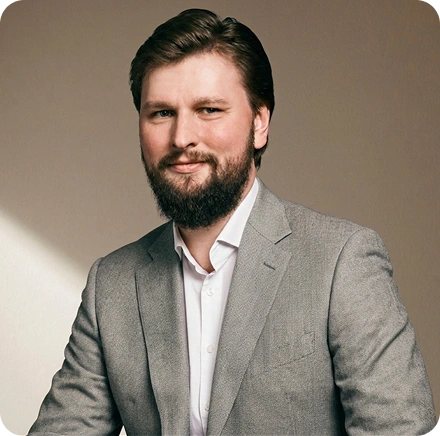
I've spent twelve years inside this problem. I trained as a fiduciary: Swiss GAAP, audits, client dossiers, the quarterly deadline. But I came at it from two directions at once. My background is split between finance and computer science, and so was my work. Early on I split my time between doing client books by hand and building an ERP meant to automate the same work. Doing both taught me exactly where the software stops and the person has to take over.
- Swiss GAAP
- Audits
- Client dossiers
Proven at scale
Later I co-founded a technology-first fiduciary firm and put the idea to the test: more than 150 businesses, over 100'000 documents, across cantons, languages, and industries. The bookkeeping was never the hard part. Reading each document and working out what it meant for the business was, and no software would do that. Along the way I also built an agentic AI system that drafts Swiss legal contracts in three languages, which showed me that AI was finally good enough to handle real, regulated work to a professional standard.
No single one of these was SoloDesk. But between them I'd lived the problem as a fiduciary and learned to solve it as an engineer. So I've decided to build the system I always wished I could hand my clients.
Why Switzerland
We're starting in Switzerland on purpose. There's a lot to navigate here: twenty-six cantons, four languages, QR-bills, and Swissdec. That complexity is what has kept the AI-native global players away so far, and also why a system designed around it from the start is worth more than one retrofitted later.
- twenty-six cantons
- four languages
- QR-bills
- Swissdec
The full vision won't ship at once, but the architecture will, and the direction holds. If your business has been waiting for software that thinks, it's here. Come and have a look.